AccueilMarocGuidesArticle

Morocco Corporate Tax Rate in 2026: The Two-Rate System

What is the corporate tax rate in Morocco in 2026? The 2023 Finance Law reformed the IS system to two flat rates: 20% (standard) and 35% (large companies and banks). Full guide.
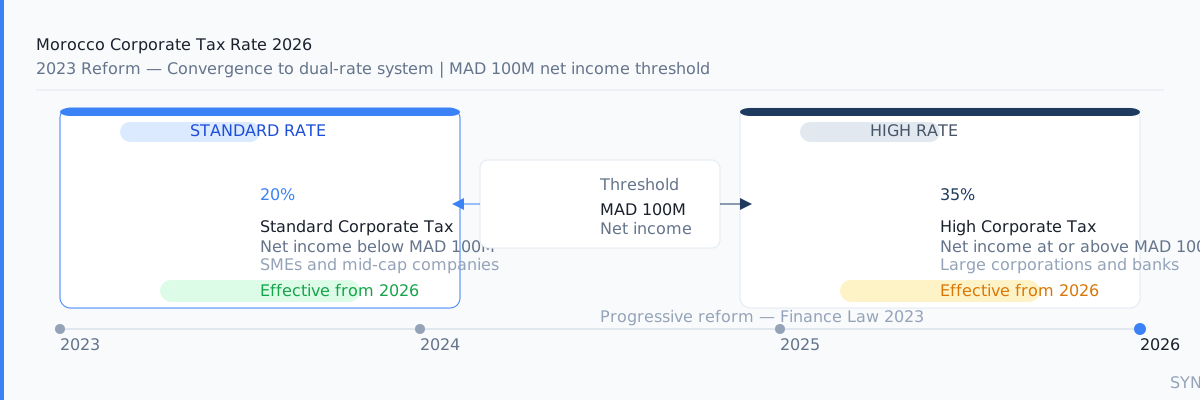
Morocco corporate tax rate 2026 — 20% standard, 35% large companies and banks. 2023 IS reform
🔍 Analyze Moroccan CompaniesAccéder →

Morocco's New Two-Tier Corporate Tax System

Morocco's corporate income tax (Impôt sur les Sociétés, or IS) underwent a major reform through the 2023 Finance Law. The reform replaced the previous progressive bracket system with a simplified two-rate structure, implemented gradually between 2023 and 2026.

As of 2026, two rates apply: a standard rate of **20%** for companies with net taxable profit up to MAD 100 million, and a higher rate of **35%** for companies with net taxable profit exceeding MAD 100 million. Financial institutions — banks, insurance companies, leasing companies and credit institutions — also apply the 35% rate regardless of their profit level.

The Old Progressive Tax System

Before the 2023 reform, Morocco's corporate tax was calculated using a progressive bracket system. Small businesses with profits below MAD 300,000 were taxed at 10%. Mid-sized companies paid 20% up to MAD 1 million in profit, and 31% beyond that. Banks and insurers faced a higher specific rate of 37%.

This complexity created administrative burden and sectoral distortions. The reform aims to make Morocco's tax system more readable and competitive for both domestic and foreign investors — aligning the country with international norms as measured by indices like Doing Business and Paying Taxes.

The MAD 100 Million Threshold

The MAD 100 million net taxable profit threshold is the central dividing line of the new system. Companies below this threshold apply 20% on their entire taxable profit. Companies above it apply 35% on their entire taxable profit — not just on the excess above MAD 100 million.

This creates a notable cliff effect: a company with MAD 99 million in profit pays MAD 19.8 million in corporate tax, while a company with MAD 101 million pays MAD 35.35 million. This non-linearity must be considered in financial planning and M&A valuations of Moroccan companies approaching this threshold.

Who Pays 35%?

Beyond companies with profits exceeding MAD 100 million, the 35% rate applies by statute to: commercial banks and credit institutions, insurance and reinsurance companies, leasing companies (crédit-bail), and microcredit associations.

This means that Morocco's entire financial sector — which makes up a significant share of the Casablanca Stock Exchange's market capitalization — operates under the 35% corporate tax rate. Analyzing Moroccan banks or insurers requires accounting for this higher tax burden when modeling net earnings and distributable profits.

Transition Period and Annual Adjustments

The convergence to the two-rate system was not immediate in 2023. Each annual Finance Law introduces a step in the convergence, moving rates gradually toward 20% and 35% to avoid abrupt fiscal shocks. Companies that previously enjoyed a 10% rate see it increase progressively; banks that paid 37% see it decrease toward 35%.

By 2026, the transition is complete and the system is fully in place with only two rates. This phased approach was designed to give businesses time to adapt their financial projections, investment plans, and dividend policies to the new reality.

Corporate Tax and Investment Analysis

Understanding Morocco's corporate tax rate is fundamental to any investment analysis involving Moroccan companies. The effective tax rate directly determines net distributable profit, return on equity (ROE), and dividend capacity.

SYNTA-IQ provides access to the financial statements of Moroccan companies as filed with the OMPIC business registry. Analysts can review balance sheets, income statements (CPC), and derive effective tax rates and profitability ratios for comparative analysis across companies and sectors.

Analyze Moroccan Companies

Accédez aux informations légales et financières de toutes les entreprises marocaines.

Analyze Moroccan Companies

Explorer

Réforme IS Maroc 2023 (FR)Morocco Dividend Withholding TaxMorocco CSS Solidarity TaxMorocco Top CompaniesCasablanca Stock Exchange

Autres guides

📖 Comment vérifier une entreprise au Maroc📖 ICE Maroc : tout savoir sur l'Identifiant Commun de l'Entreprise📖 Registre de commerce au Maroc : guide complet📖 Comment consulter le bilan financier d'une entreprise au Maroc📖 Comment négocier son salaire au Maroc en connaissance de cause📖 Comment consulter les résultats financiers d'une entreprise marocaine📖 Comment identifier les fournisseurs et clients d'une entreprise au Maroc📖 Appels d'offres et marchés publics au Maroc : guide complet📖 Dividendes à la Bourse de Casablanca en 2026 : tout savoir📖 Salaires au Maroc par secteur en 2026 : ce que gagne-t-on vraiment📖 Les plus grandes entreprises au Maroc en 2026📖 Taux de l'IS au Maroc en 2026 : la convergence vers 20% et 35%📖 Réforme de l'Impôt sur les Sociétés au Maroc : tout comprendre📖 CSS au Maroc : Contribution Sociale de Solidarité expliquée📖 Retenue à la source sur les dividendes au Maroc : guide complet📖 Fiscalité des dividendes au Maroc : IS, retenue à la source et CSS📖 Morocco Dividend Withholding Tax: Everything You Need to Know📖 Morocco's Social Solidarity Contribution (CSS) Explained📖 Comment vérifier un client ou fournisseur étranger depuis le Maroc📖 Risque d'impayé client au Maroc : comment l'évaluer et le prévenir📖 Sécuriser ses paiements internationaux depuis le Maroc📖 Commerce bilatéral France-Maroc : guide pratique pour les entreprises📖 Comment trouver et qualifier des partenaires commerciaux à l'international depuis le Maroc📖 SA, SARL, SAS au Maroc : choisir la bonne forme juridique📖 Annonces légales au Maroc : Bulletin Officiel, JAL et publications obligatoires📖 Due diligence sur une entreprise marocaine : guide complet📖 Évaluer le risque crédit d'un client ou fournisseur marocain📖 Identifiant fiscal au Maroc (IF) : trouver, vérifier, comprendre📖 CNSS et affiliation des entreprises au Maroc : guide complet📖 Radiation, dissolution et liquidation d'entreprise au Maroc📖 Score de risque entreprise au Maroc : évaluer la solidité financière📖 Rapport entreprise Maroc : accéder à la fiche complète d'une société📖 Scoring crédit PME au Maroc : méthodes et indicateurs pour les analystes📖 Analyste crédit au Maroc : méthodes et outils d'analyse financière📖 Assurance crédit export au Maroc : SMAEX, garanties et protection des exportateurs📖 Délais de paiement au Maroc : tout comprendre sur la loi 49-15📖 Crédit documentaire au Maroc : fonctionnement, types et banques📖 Vérifier un fournisseur marocain : qualification, solvabilité et risque📖 Information entreprise au Maroc : où trouver les données officielles📖 Numéro d'Identification Fiscale au Maroc : guide complet sur le NIF/IF📖 Vérification ICE au Maroc : guide pratique étape par étape📖 Recherche IF DGI : comment trouver un Identifiant Fiscal sur le portail SIMPL📖 Valorisation d'entreprise au Maroc : méthodes et pratiques📖 Transmission d'entreprise au Maroc : cession, succession et reprise📖 MBO et MBI au Maroc : le rachat d'entreprise par les dirigeants📖 LBO et Private Equity au Maroc : financer la croissance et la cession📖 Méthode des multiples d'EBITDA au Maroc — Fourchettes sectorielles 2026📖 Céder son entreprise au Maroc en 2026 — Guide complet étape par étape📖 Méthode DCF pour valoriser une PME marocaine en 2026 — Exemple complet📖 Valorisation d'une pharmacie au Maroc en 2026 — Prix et méthodes📖 Fiscalité de la cession d'entreprise au Maroc en 2026📖 Méthode des comparables boursiers au Maroc — Bourse de Casablanca et transactions privées📖 Valorisation par l'actif net au Maroc — Quand l'utiliser et comment calculer📖 Valoriser une startup ou entreprise tech au Maroc en 2026📖 Transmission familiale d'entreprise au Maroc en 2026📖 Les 7 erreurs qui détruisent la valeur de votre entreprise avant la cession au Maroc📖 Qui sont les acteurs du M&A et de la transmission d'entreprise au Maroc en 2026 ?

Guide mis à jour en mars 2026 · Données officielles OMPIC

SYNTA-IQ — Intelligence économique et financière · Maroc