Morocco Dividend Withholding Tax: Everything You Need to Know
Morocco applies a 15% withholding tax (RAS) on dividends paid to individuals. Discover how it works for residents, non-residents, holding companies, and under tax treaties. Full 2026 guide.
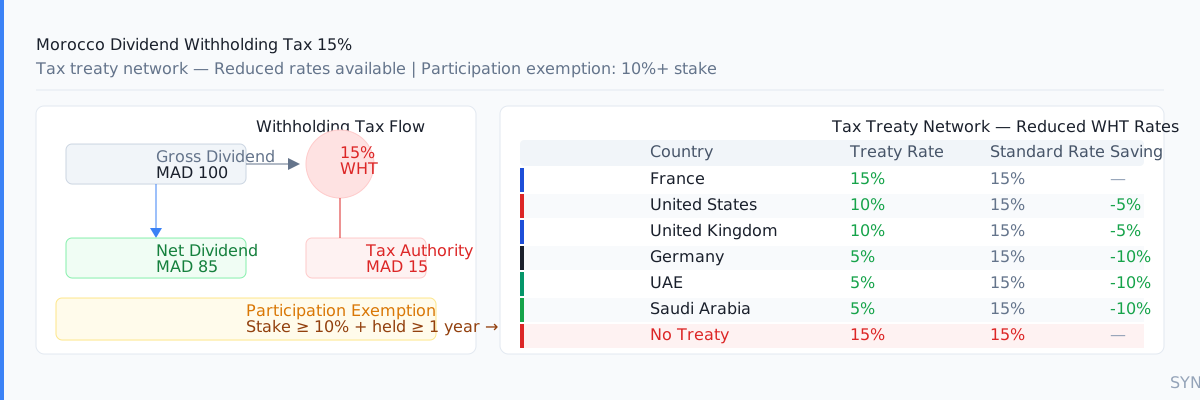
Overview: Morocco's 15% Dividend Withholding Tax
Morocco levies a withholding tax (retenue à la source, or RAS) of **15%** on dividends distributed by Moroccan companies to individual shareholders. This rate applies both to resident and non-resident individuals, subject to applicable tax treaties.
The withholding is applied at the source by the distributing company, which is responsible for collecting and remitting the tax to the Directorate General of Taxes (DGI) on behalf of the shareholder. For resident individuals, this withholding is final and liberatory — meaning the dividend income does not need to be declared again in the annual personal income tax (IR) return.
Who Is Subject to the Withholding Tax?
Individual shareholders (natural persons) who receive dividends from Moroccan companies — whether listed or unlisted — are subject to the 15% withholding. This includes shareholders of SARLs, SAs, SAS, and other corporate forms.
For corporate shareholders (companies subject to IS), a different regime applies. Moroccan companies receiving dividends from their Moroccan subsidiaries can benefit from a participation exemption (régime mère-fille) that eliminates double taxation within corporate groups, provided certain minimum shareholding and holding period conditions are met.
Tax Treaties and Reduced Rates for Non-Residents
Morocco has concluded tax treaties with many countries — including France, Spain, Belgium, the Netherlands, Germany, the United Arab Emirates, Saudi Arabia, and others — that may reduce the standard 15% withholding rate on dividends for non-resident shareholders.
Under the Franco-Moroccan tax treaty, for instance, the withholding rate on dividends may be reduced to 5% or 10% depending on the level of participation held by the French company in the Moroccan one. Claiming a treaty-reduced rate requires formal documentation: a certificate of tax residency from the investor's country and compliance with anti-abuse provisions.
Participation Exemption for Corporate Shareholders
The participation exemption (régime mère-fille) is one of the most significant provisions in Moroccan tax law for corporate investment structures. Under this regime, dividends received by a Moroccan parent company from a Moroccan subsidiary are substantially exempt from tax, avoiding cascading taxation at each level of the corporate structure.
This exemption is particularly relevant for private equity structures, family holding companies, and multinational groups operating in Morocco through local holding entities. The conditions typically include a minimum shareholding percentage and a minimum holding period for the participation.
Total Tax Burden on Moroccan Dividends
For a resident individual shareholder in Morocco, the total tax burden on dividends combines several layers: the corporate income tax (IS) paid by the company on its profits (20% or 35%), the 15% withholding tax on the gross dividend, and the Contribution Sociale de Solidarité (CSS) on profits and/or distributions.
Example: A company earns MAD 1,000,000 in taxable profit, pays IS at 20% (MAD 200,000), and distributes the remaining MAD 800,000. The shareholder's 15% RAS amounts to MAD 120,000. Net dividend received: MAD 680,000. Effective total tax rate on original profit: 32% before CSS. Adding CSS increases the combined burden further.
Dividends from Casablanca Stock Exchange Companies
For publicly listed companies on the Casablanca Stock Exchange (Bourse de Casablanca / BVC), dividend distributions follow the same taxation rules. The company withholds 15% on dividends paid to individual shareholders at the time of distribution.
Investors in Moroccan listed equities should distinguish between the gross dividend per share and the net dividend actually received after withholding. SYNTA-IQ provides access to the financial data of Moroccan companies — including Casablanca-listed firms — to help analysts model dividend capacity, payout ratios, and net yields.
Explore Moroccan Company Financials
Accédez aux informations légales et financières de toutes les entreprises marocaines.
Explore Moroccan Company Financials →