Morocco's Social Solidarity Contribution (CSS) Explained
What is Morocco's Contribution Sociale de Solidarité (CSS)? How does it apply to corporate profits and dividend distributions? Full guide for investors and analysts.
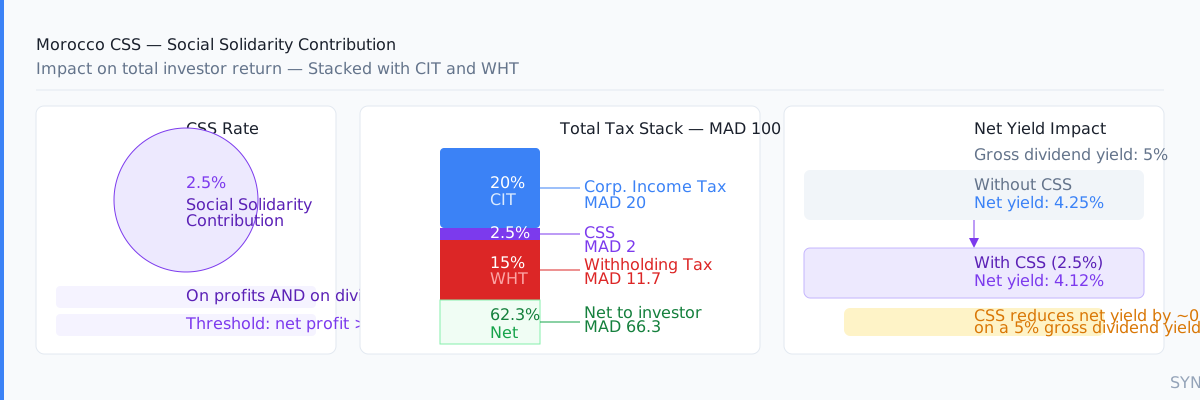
What Is the CSS in Morocco?
The Contribution Sociale de Solidarité (CSS) is a solidarity surcharge introduced by Morocco's 2021 Finance Law in response to the COVID-19 pandemic. It was designed to fund the country's social protection expansion programs, including the extension of health insurance coverage and the Mohammed VI Investment Fund.
The CSS is levied in addition to the corporate income tax (IS). It constitutes an additional layer of taxation on profitable Moroccan companies. Since its introduction, the CSS has been maintained and adjusted through successive Finance Laws, reflecting its role as a structural fiscal instrument rather than a purely temporary emergency measure.
How Is the CSS Calculated?
The CSS on corporate profits is calculated on the net taxable result of the company, after IS deduction. It applies above a minimum threshold of net profit, meaning small companies with low or zero profits are generally not affected.
The applicable rate and threshold vary by Finance Law year. As Morocco's Finance Laws are enacted annually, the CSS rate may be adjusted each year. Investors and tax practitioners should verify the current parameters in the Finance Law applicable to the fiscal year under review. The CSS is declared and paid simultaneously with the IS, via the same DGI filing channels.
CSS on Dividend Distributions
Beyond its application on corporate profits, the CSS also applies to dividend distributions in certain configurations. When a Moroccan company distributes dividends, the CSS can represent an additional levy on the distribution — on top of the 15% dividend withholding tax (RAS).
This means that the full tax burden on dividends distributed by a profitable Moroccan company includes: IS on profits (20% or 35%), CSS on profits, 15% RAS on the gross dividend distributed to individual shareholders, and CSS on the distribution. Understanding all these layers is essential for modeling the true net yield of a Moroccan equity investment.
Impact on Casablanca Stock Exchange Companies
Listed companies on the Casablanca Bourse (BVC) are subject to the same CSS framework as unlisted companies. The CSS reduces the amount of profit available for distribution, which in turn affects dividend per share and dividend yield calculations.
When analyzing listed Moroccan companies, financial models should explicitly account for the CSS as a separate line item from IS. Ignoring the CSS leads to an overestimation of distributable profits and net dividend yields. SYNTA-IQ provides financial data sourced from official Moroccan filings to support accurate analysis of listed and unlisted companies.
CSS and the Banking/Insurance Sector
Banks and insurance companies in Morocco — already subject to the 35% IS rate — also bear the CSS on their profits and dividends. The financial sector thus faces the highest combined tax burden among Moroccan industries: 35% IS + CSS on profits + 15% RAS on dividends to shareholders.
Despite this fiscal pressure, Morocco's banking sector remains highly profitable and capital-generative. The major Moroccan banks maintain strong dividend payout ratios and are significant contributors to the overall dividend market at the Casablanca Stock Exchange, making dividend analysis particularly relevant for bank investors.
Planning Around the CSS
For investors and company executives, understanding the CSS is critical for financial projections, valuation models, and payout policy decisions. The CSS increases the effective combined tax rate on profits beyond the IS alone, and must be factored into any comprehensive tax modeling of Moroccan companies.
SYNTA-IQ's financial data covers the full income statement (CPC) and balance sheet of Moroccan companies, including the tax charge lines. Analysts can use this data to compute effective tax rates, compare across sectors, and evaluate how CSS impacts distributable earnings at the company level.
Analyze Moroccan Company Tax & Dividends
Accédez aux informations légales et financières de toutes les entreprises marocaines.
Analyze Moroccan Company Tax & Dividends →